
For most of the last fifty years, muscle was treated as a vanity project. It was what bodybuilders chased and what everyone else politely ignored while focusing on cardiovascular fitness, cholesterol and body weight.
That view has quietly collapsed. Muscle is now understood as one of the most metabolically active tissues in the human body, and the amount you carry into your sixties and seventies is among the strongest predictors of how those decades will go.
This is not a training philosophy. It is a reclassification. Muscle is being treated as an organ.
What an organ actually does
An organ is a tissue that performs a specific physiological function beyond its structural role. By that definition, skeletal muscle qualifies several times over.
It is your primary glucose sink. Skeletal muscle takes up the majority of the glucose your body disposes of after a meal. More muscle means more capacity to clear blood sugar, which is why muscle mass tracks so closely with insulin sensitivity. Less muscle means the same meal puts more strain on the same system, year after year.
It is an endocrine tissue. Contracting muscle releases signalling molecules known as myokines, which travel through the bloodstream and act on other tissues including the liver, fat cells, bone and brain. This is the mechanism behind a great deal of what exercise does that has nothing to do with the muscle itself.
It is your amino acid reserve. During illness, injury or surgery, the body draws on muscle protein to fuel the immune response and repair tissue. Someone with more muscle has a larger reserve to draw on. This is one of the least discussed reasons that muscle mass predicts survival after serious medical events.
It is what loads your skeleton. Bone remodels in response to mechanical stress, and most of that stress comes from muscle pulling on it. Bone density and muscle mass decline together because they are mechanically linked, not because they happen to age at the same time.
The metabolic argument
Consider two people of the same age, height and body weight. One carries meaningfully more lean mass than the other.
The person with more muscle clears glucose more efficiently, runs a higher resting metabolic rate, has more capacity to absorb the metabolic cost of a bad week, and has a larger buffer between where they are and the threshold at which metabolic dysfunction starts to show up on blood work.
The person with less muscle can be the same weight, wear the same size and look entirely healthy. Body weight and body composition are different questions, and only one of them is predictive.
This is the single most useful reframe for anyone over forty. The goal is not to weigh less. The goal is to carry more functional tissue and less of everything else.
The functional argument
The metabolic case is compelling but abstract. The functional case is the one people feel.
Independence in later life comes down to a small set of physical capacities: getting off the floor, carrying your own shopping, climbing stairs, catching yourself when you trip, and getting out of a chair without assistance. Every one of those is a strength task.
The threshold effect here matters. Strength does not need to decline to zero for independence to be lost. It only needs to fall below the level required for a specific task. Someone can be fully independent one year and unable to rise from a low chair the next, having lost only a small increment of strength, because they were sitting just above the threshold.
Building a larger reserve is what puts distance between you and that threshold. That is the entire longevity argument in one sentence.
Why this changes what training is for
If muscle is an organ, then resistance training is not a cosmetic activity. It is organ maintenance.
That reframe changes several decisions:
- It changes what you measure. Weight becomes a poor metric and strength becomes the primary one. Two people can lose the same five kilograms with completely opposite health outcomes depending on what the five kilograms was made of.
- It changes the priority order. Cardiovascular work remains essential. But if you only have two or three sessions a week, resistance training earns the first slot, because cardio does not preserve muscle and resistance training does improve cardiovascular markers.
- It changes the time horizon. You are not training for a goal in twelve weeks. You are maintaining a tissue for the next forty years.
We covered the adjacent measurement question, VO2 max and grip strength, in the two numbers that predict your future. Those two markers and lean mass form the practical dashboard.
The part most people get wrong
The most common mistake is not doing nothing. It is doing the wrong thing consistently for years.
Long steady cardio, done exclusively, does not defend muscle mass. Neither does very light resistance work performed at the same load month after month. Muscle adapts to what it is asked to do and then stops. Without progression, a resistance programme becomes maintenance at best and a slow decline at worst.
The second most common mistake is starting too late and too hard. People who realise the problem at fifty-five often try to make up two decades in six weeks, get injured, and conclude that strength training is not for them.
Neither failure is about effort. Both are about structure.
What structured looks like in practice
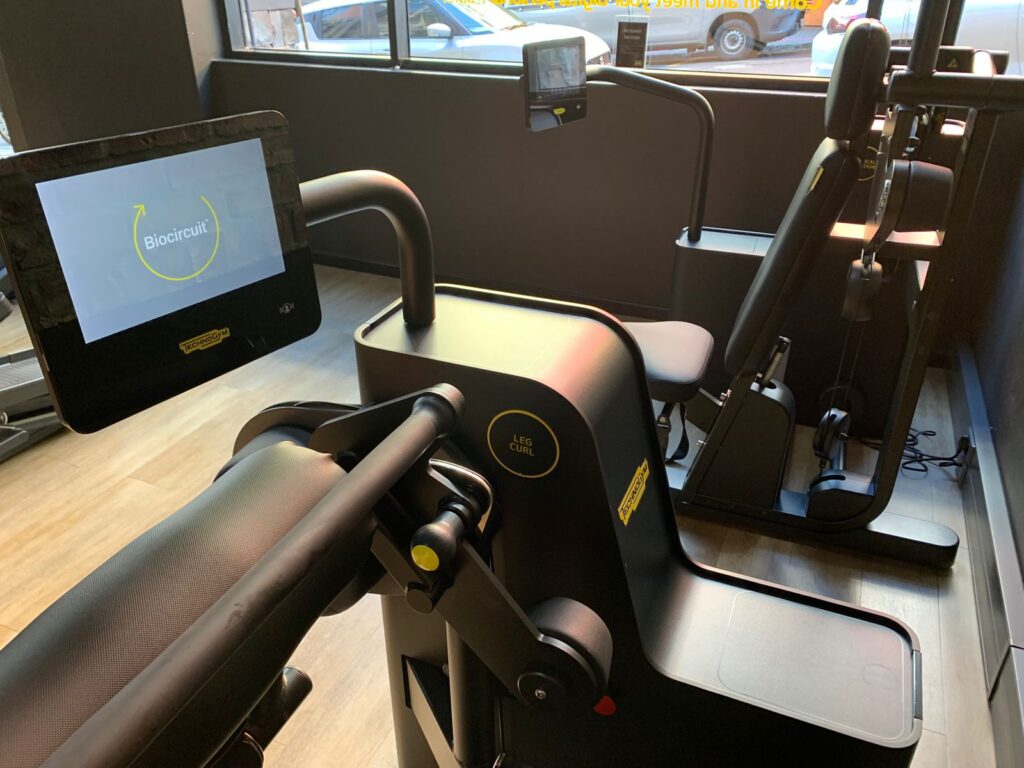
At threezero, the Technogym Biocircuit handles the structure so that the member does not have to. The machine recognises you, adjusts to your body, sets the resistance based on your current strength, and increases the load as you improve. The circuit takes thirty minutes and covers the major movement patterns.
The value is not that it is easier. The value is that it is progressive and repeatable, which are the two properties that decide whether a programme still exists in eighteen months.
Average member result. 14% increase in strength over three months.
Threezero is a Vitality Accredited Fitness centre in Cape Quarter, Green Point. If you want the background on why the studio was built around thirty-minute guided strength rather than a conventional gym floor, what longevity training actually means covers it.
The takeaway
Muscle is not what you build to look a certain way. It is the tissue that regulates your blood sugar, buffers you through illness, loads your skeleton, signals to your brain and decides whether you can get off the floor at eighty.
Treating it as an organ rather than an accessory is the most useful shift a person over forty can make. And unlike most organs, this is one you can measurably improve, at any age, in about ninety minutes a week.
Book a trial session at threezero Cape Quarter and get a baseline you can build from.


Pingback: How Much Protein Do You Really Need to Build Muscle After 40? - Threezero